
Consent-aware AI workflows
Consent is a distributed state: keep browser and backend in agreement
A banner is not the consent system. The browser, request payload, backend policy, storage, and downstream integrations must all interpret the same decision and version.
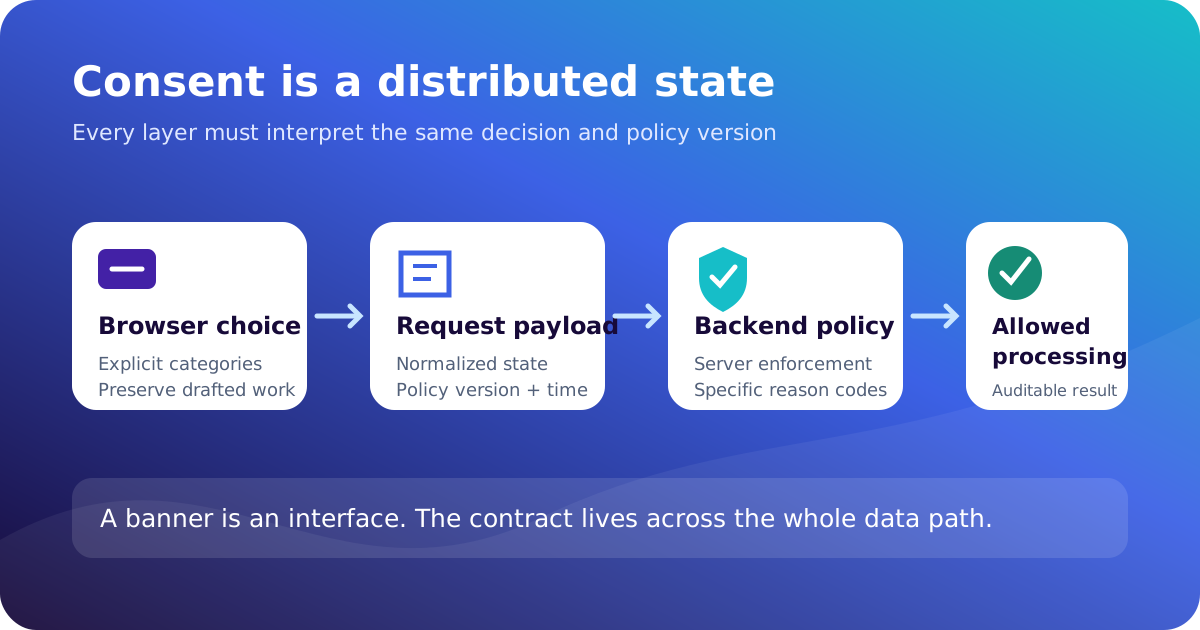
Consent bugs often look contradictory: the visitor accepted the banner, but the API rejects the message; or the interface allows a file upload while the backend treats processing as unapproved. The root cause is usually architectural. Consent was implemented as a visual component instead of a distributed state shared by every layer that handles the data.
Model a small, explicit state machine
Use named states such as unknown, essential-only, approved categories, and withdrawn. Store the decision time and the policy version that the user saw. Avoid inferring approval from the absence of a choice, a pre-checked control, or a browser capability. Product and legal owners should define which categories are required for each operation.
Send the decision with the operation
Local browser storage is useful for continuity, but it is not evidence the backend can trust on its own. Every sensitive request should carry the normalized consent state and policy version. The backend then validates that state against the requested operation. A chat message, file upload, analytics event, and contact form can have different requirements.
{
  "consent": {
    "policy_version": "2026-07-13",
    "functional": true,
    "analytics": false,
    "decided_at": "2026-07-13T12:00:00Z"
  }
}
Enforce policy on the server
Disabling a button in JavaScript is a helpful interface cue, not an access control. The backend must reject or constrain operations whose required state is missing. It should return a specific reason code the browser can translate into a durable next step rather than a generic error.
Preserve work when state changes
If the user needs to review or update consent, do not erase the drafted message or form. Open the preference surface, explain the required category in context, and resume the operation only after an explicit decision. Withdrawal should stop future optional processing and trigger the agreed downstream procedure without pretending that every historical record can simply disappear.
Log transitions without leaking content
Operational logs need the submission or session identifier, previous and new consent states, policy version, decision source, result code, and timestamp. They usually do not need the message body, uploaded document, email address, or authentication token. This gives support enough evidence to diagnose a boundary while limiting exposure.
Test the disagreement cases
- A new browser with no stored decision.
- A stored decision for an old policy version.
- The browser says approved but the request omits the consent object.
- The request is valid but the backend requires a different category.
- Consent is withdrawn while a retry is pending.
- JavaScript is unavailable and the user still needs a readable path and contact alternative.
Consent is reliable when every layer can explain the same decision, policy version, and allowed operation.
Continue from evidence to implementation
Build a consent-aware AI interface See a controlled lead qualification workflow Next: define when a lead is really acceptedPrimary sources
AI assisted with structure and language; the implementation pattern, checks, and conclusions were reviewed by a human. This note is technical guidance, not legal advice. Editorial review: Intelligency Studio editorial review.